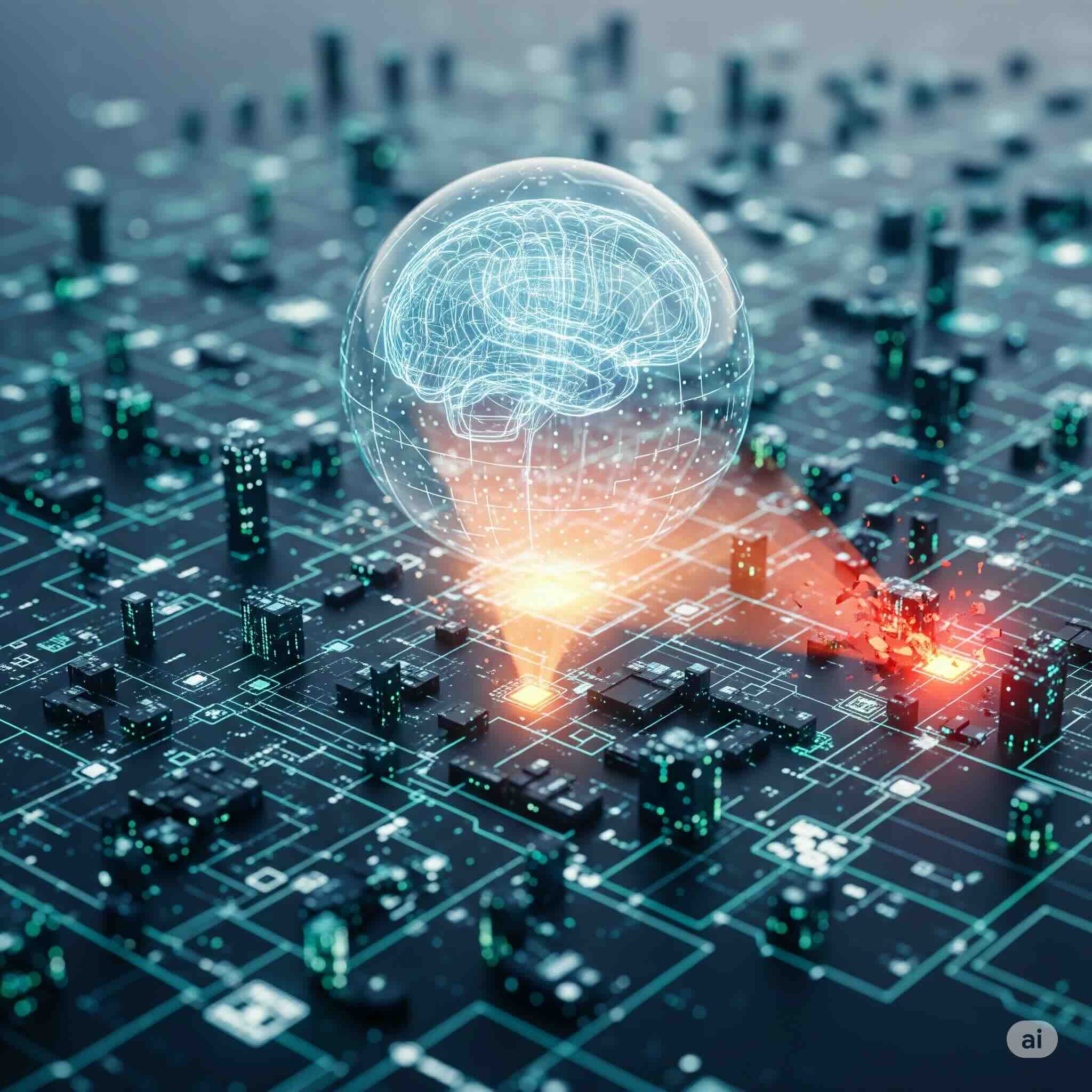
Predictive Maintenance for Software: Using AI to Prevent System Failures
By Tom Lang on March 3, 2025
We've all experienced it: a software application suddenly crashes, a website goes down, or a critical system freezes, bringing business operations to a grinding halt. These unforeseen failures are not just inconvenient; they can lead to significant financial losses, reputational damage, and frustrated users. Historically, software maintenance has often been reactive – fixing issues after they occur. But what if we could predict these failures before they happen?
Enter the world of Predictive Maintenance for Software, a revolutionary approach powered by Artificial Intelligence (AI). Drawing inspiration from its success in preventing mechanical breakdowns, AI is now being applied to complex software systems, enabling organizations to move from a reactive "break-fix" model to a proactive, intelligent, and continuously stable operational environment.
The Core Concept: Predicting the Unpredictable
At its heart, predictive maintenance for software leverages AI and Machine Learning (ML) to analyze vast quantities of operational data to identify patterns that precede system failures. Instead of waiting for a crash report, AI can detect subtle deviations from normal behavior, flag potential issues, and alert teams to intervene before a catastrophic event occurs.
Here's how AI is transforming software reliability:
1. Data Ingestion and Aggregation:
The first step is to collect comprehensive data from every layer of the software stack. This includes:
- Application Logs: Error messages, warnings, critical events, and general operational logs.
- Performance Metrics: CPU utilization, memory consumption, network latency, database query times, API response times, and throughput.
- Infrastructure Telemetry: Data from servers, containers, virtual machines, and cloud services.
- User Behavior Data: Patterns of user interaction, common workflows, and navigation paths.
- Historical Incident Data: Records of past failures, their root causes, and resolution steps.
- Configuration Data: Changes in system configurations, code deployments, and environmental settings.
2. Intelligent Anomaly Detection:
With this massive influx of data, AI models learn what "normal" looks like for a given system. They then continuously monitor real-time data streams to identify any deviations or anomalies.
- Behavioral Baselines: ML algorithms build baselines of typical system performance and user interaction.
- Outlier Identification: Even subtle shifts, such as a slight increase in API response time, an unusual spike in error logs, or a change in user access patterns, can be flagged as potential indicators of an impending problem. These are often too minor or too numerous for humans to spot effectively.
3. Pattern Recognition and Correlation:
A single anomaly might not signify a major issue, but a combination of seemingly disparate anomalies could point to a critical problem. AI excels at:
- Event Correlation: Connecting seemingly unrelated events across different system components to reveal the true underlying cause of an issue. For example, a minor database slowdown combined with an increase in failed user logins and a specific network error could collectively signal an application-wide outage in the making.
- Learning Failure Signatures: Over time, AI models learn the specific "signatures" or sequences of events that typically precede known system failures, allowing for highly accurate predictions.
4. Predictive Analytics and Forecasting:
This is where the "predictive" power truly shines. AI models can:
- Forecast Future State: Based on current trends and historical data, AI can predict when a specific component might degrade or fail, or when system capacity might be exceeded.
- Risk Scoring: Assign a risk score to different parts of the application or infrastructure, indicating their likelihood of failure in the near future.
- "Remaining Useful Life" for Software Components: While more common for hardware, AI can analyze trends in software components (e.g., a specific microservice's error rate) to estimate its "remaining stable life" before it might require intervention.
5. Proactive Intervention and Remediation:
Once a potential failure is predicted, the system can trigger automated or human-led actions:
- Automated Alerts: Notifying relevant IT or development teams with specific, actionable insights rather than generic error messages.
- Automated Remediation: For well-defined and understood issues, AI can trigger automated actions, such as scaling up resources, restarting a problematic service, rolling back a recent deployment, or rerouting traffic.
- Prescriptive Recommendations: Providing precise recommendations for human intervention, including the likely root cause, affected components, and suggested fixes.
The Unpacking of Benefits
Implementing predictive maintenance for software, driven by AI, offers a multitude of compelling advantages:
- Reduced Downtime and Outages: The most significant benefit is the shift from reactive to proactive, minimizing costly unplanned outages and ensuring continuous service availability.
- Improved System Reliability and Performance: By catching issues before they escalate, AI helps maintain optimal system health, leading to better performance and a more stable user experience.
- Faster Troubleshooting and MTTR: AI's ability to pinpoint root causes rapidly drastically reduces the Mean Time To Resolution (MTTR) when an issue does occur.
- Optimized Resource Allocation: By understanding potential future needs (e.g., capacity bottlenecks), IT teams can proactively scale resources, preventing over-provisioning or under-provisioning.
- Cost Savings: Preventing outages, reducing troubleshooting time, and optimizing resource use directly translate into significant operational cost savings.
- Enhanced User Experience: Stable, high-performing applications lead to happier customers and a more positive brand perception.
- Reduced Alert Fatigue: Intelligent correlation and anomaly detection filter out the noise, ensuring that IT teams only respond to actionable, high-priority alerts.
- Data-Driven Decision Making: AI provides deep insights into system health and potential risks, empowering IT leaders to make more informed strategic decisions.
Challenges and the Evolving Role of Humans
While transformative, implementing AI-powered predictive maintenance for software is not without its hurdles:
- Data Volume and Quality: Requires massive amounts of high-quality, clean, and well-structured operational data. Data silos and inconsistencies can be significant obstacles.
- Integration Complexity: Integrating AI platforms with diverse existing monitoring tools, logging systems, and infrastructure can be challenging.
- Model Training and Refinement: Building and continuously refining ML models requires expertise in data science, machine learning, and domain-specific knowledge of the software system.
- False Positives: While AI reduces noise, some false positives may still occur, requiring human validation. Over time, models learn to reduce these.
- Explainability: Understanding why an AI model predicted a certain failure can sometimes be opaque. Explainable AI (XAI) is an emerging field working to address this, as human trust and understanding are crucial.
- Security and Privacy: Ensuring the security and privacy of sensitive operational data used for AI training and analysis is paramount.
The role of IT operations professionals is evolving from "firefighters" to "engineers of reliability." They will work collaboratively with AI, leveraging its predictive power to focus on strategic improvements, complex problem-solving, and continuous optimization, rather than constantly reacting to crises.
The Future of Resilient Software
Predictive maintenance for software is not a distant dream; it's a rapidly maturing reality. As AI capabilities continue to advance, we will see increasingly sophisticated models that can:
- Understand the intricate dependencies across highly distributed microservices architectures.
- Predict "cascading failures" before they even begin.
- Provide more precise prescriptive actions, potentially even self-healing for a wider range of issues.
- Integrate seamlessly into existing DevOps and AIOps practices, creating truly intelligent and resilient software ecosystems.
By embracing AI for predictive software maintenance, organizations can build more robust, reliable, and continuously available systems, ensuring that their digital services remain uninterrupted and their users remain delighted. It's about securing the future of your software by understanding its present.
← Back to Our Insights