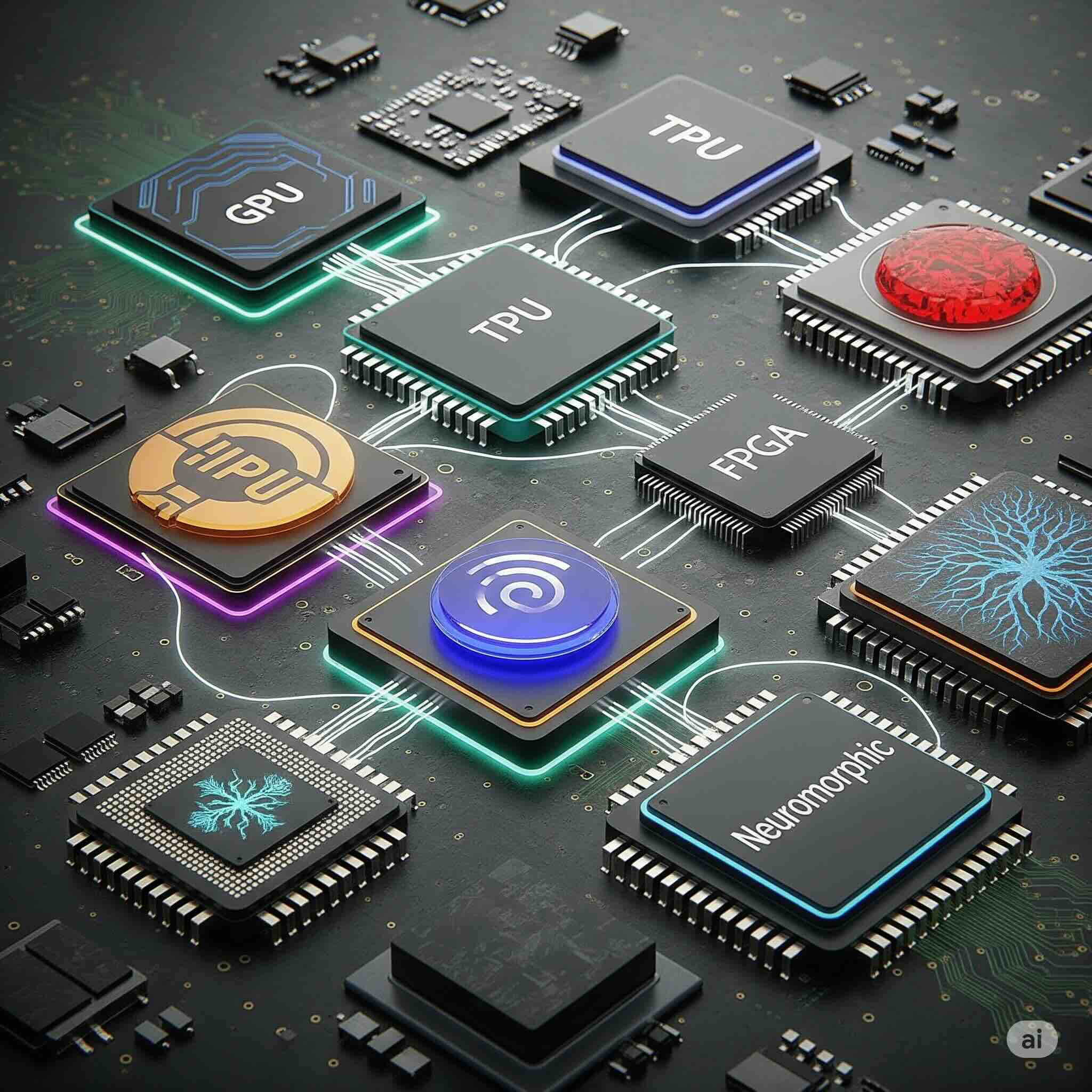
Beyond GPUs: Exploring Specialized Hardware for AI Acceleration
By Tom Lang on June 16, 2025
For years, when we thought of powerful AI, we thought of Graphics Processing Units (GPUs). NVIDIA, in particular, has dominated the landscape, with GPUs becoming the de facto standard for training massive deep learning models due to their parallel processing capabilities. GPUs are incredibly versatile, excelling at the kind of matrix multiplications that underpin neural networks, and their widespread availability and robust software ecosystems make them a logical choice. However, the relentless demand for more computational power, lower latency, and greater energy efficiency in AI has spurred innovation far beyond the GPU. A new breed of specialized hardware is emerging, purpose-built to accelerate specific AI workloads more effectively than general-purpose GPUs. These "AI accelerators" are becoming increasingly vital as AI moves from research labs to ubiquitous deployment at the edge, in data centers, and within consumer devices. Let's delve into some of these exciting alternatives and understand why they are shaping the future of AI infrastructure.
1. Tensor Processing Units (TPUs): Google's Custom Powerhouses
Designed by Google, Tensor Processing Units (TPUs) are Application-Specific Integrated Circuits (ASICs) specifically optimized for machine learning workloads using TensorFlow (though now supporting other frameworks).
- Key Advantage: TPUs are built from the ground up to excel at large-scale matrix multiplications and convolutions, the core operations in deep learning. They often feature large on-chip memory and high-bandwidth interconnects, allowing them to rapidly feed data to the processing units.
- Ideal Use Cases: Primarily for training large-scale deep learning models, especially those used in Google's own services (Search, Translate, Photos). Cloud TPUs are available to external developers for intense training tasks.
- Why they shine: For specific deep learning workloads, TPUs can offer significant performance gains and often better power efficiency than GPUs, particularly when scaled up in "pods" for massive training runs.
2. Field-Programmable Gate Arrays (FPGAs): The Reconfigurable Workhorses
Unlike fixed-function ASICs, Field-Programmable Gate Arrays (FPGAs) are integrated circuits whose logic can be reconfigured after manufacturing.
- Key Advantage: FPGAs offer a unique blend of flexibility and performance. You can program them to implement custom hardware logic precisely tailored to a specific AI algorithm or neural network architecture. This allows for fine-grained optimization of data paths and parallel execution.
- Ideal Use Cases:
- Inference at the Edge: Their lower power consumption and ability to be custom-programmed make them suitable for edge devices where energy efficiency is critical.
- Low-Latency Inference: FPGAs can offer very low and predictable latency for real-time AI applications due to their direct hardware implementation.
- Specific Algorithm Acceleration: When an AI algorithm has unique computational patterns that don't map efficiently to GPUs or general-purpose CPUs, FPGAs can be programmed to accelerate those specific operations.
- Why they shine: FPGAs bridge the gap between fixed-function ASICs (high performance, low flexibility) and GPUs (high flexibility, lower peak efficiency for specific tasks), offering reconfigurability to adapt to evolving AI models without a full chip redesign.
3. Application-Specific Integrated Circuits (ASICs): The Ultimate Performance and Efficiency
ASICs are custom-designed chips built for a single, specific purpose. While TPUs are a type of ASIC for AI, many other companies are designing their own proprietary AI ASICs.
- Key Advantage: Because they are designed for a singular task (e.g., accelerating neural network inference), ASICs can achieve the absolute highest levels of performance and energy efficiency for that task. They remove all the general-purpose overhead, leading to specialized units that execute AI operations with unparalleled speed.
- Ideal Use Cases:
- High-Volume Inference: Ideal for scenarios where a specific AI model needs to be run millions or billions of times per day (e.g., large-scale cloud inference, search ranking, recommendation engines).
- Edge Devices with Strict Power Budgets: Found in smartphones (e.g., Apple's Neural Engine), smart speakers, and IoT devices where every milliwatt of power matters.
- Why they shine: When scale and efficiency are paramount, and the AI model architecture is relatively stable, ASICs provide the most optimized solution. The trade-off is the high upfront design and manufacturing cost, and lack of flexibility once designed.
4. Neuromorphic Computing: Brain-Inspired Architectures
Moving beyond traditional Von Neumann architectures (which separate processing from memory), neuromorphic chips aim to mimic the structure and function of the human brain.
- Key Advantage: These chips integrate memory and processing more closely and often operate using "spiking neural networks" (SNNs) that fire only when a certain threshold is met, similar to biological neurons. This event-driven, massively parallel approach promises extreme energy efficiency for certain AI tasks.
- Ideal Use Cases:
- Real-time Sensory Processing: Particularly adept at tasks like continuous audio processing, visual pattern recognition, and robotics, where real-world data streams are processed efficiently.
- Low-Power Edge AI: Their energy efficiency makes them highly attractive for always-on edge devices and sensors.
- Unsupervised Learning and Adaptive Systems: Some neuromorphic architectures are well-suited for online learning and adaptation, as seen in biological brains.
- Why they shine: Neuromorphic computing represents a radical departure from conventional computing, offering the potential for breakthroughs in energy efficiency and continuous learning for specific AI workloads. It's still a nascent field but holds immense promise.
The Future is Heterogeneous
While GPUs will undoubtedly remain a cornerstone of AI for their versatility and ecosystem, the future of AI acceleration is increasingly heterogeneous. No single piece of hardware will be optimal for every AI task.
- Training vs. Inference: GPUs and TPUs currently dominate large-scale training, while ASICs and FPGAs are gaining ground for efficient inference, especially at the edge.
- Workload Specificity: As AI algorithms become more diverse, the need for hardware tailored to specific operations will grow.
- Energy Efficiency: The increasing energy consumption of massive AI models is driving the demand for more power-efficient specialized hardware.
The choice of AI hardware will depend on a careful evaluation of factors like the specific AI task, desired performance, latency requirements, power budget, cost, and the need for flexibility versus raw efficiency. By exploring beyond GPUs, organizations can unlock new levels of performance, efficiency, and innovation in their AI deployments, pushing the boundaries of what intelligent systems can achieve.
← Back to Our Insights