
AI-Augmented Technical Due Diligence: What Changes When the Code Was Written by AI
By Tom Lang on November 16, 2026
Technical due diligence used to mean two things: automated scanners check the codebase for licenses and known vulnerabilities while an expert reads the most important parts by hand, and someone interviews the team. Both still matter. But two things changed in the last couple of years, and they change the job.
The company you're buying may have written a large share of its code with AI. And the person reading that code can now read all of it, not a sample, because they're using AI too. I run diligence this way for investors, and I've also run the full packet on my own AI-built product. Here's what actually changes, what I always ask, and what you should expect to get back.
What does technical due diligence answer?
One question, before money moves: what technical and AI risk comes with this company, and what will it cost to fix?
Everything else is in service of that answer. Architecture, security, team, delivery and cost are all inputs. If a diligence report gives you a list of problems without a severity and a cost next to each one, it hasn't answered the question. It has handed you homework.
What changes when the buyer uses AI?
The old constraint was time. Scanners could cover a whole codebase for licenses and known vulnerabilities, but the human reading, the part that judges design, quality and risk, had to be selective: a reviewer reads what matters most and extrapolates. Now AI tools can do a first read of the whole thing (every module, the full commit history, the infrastructure code, the docs) in days, and the senior reviewer starts from that.
That changes what diligence can find:
- Coverage instead of sampling. Dead code, duplication, missing tests, hard-coded secrets, vulnerable dependencies and license problems get found across the entire codebase, not just the parts someone happened to open.
- History, not just a snapshot. Commit patterns show who really holds the knowledge (key-person risk), whether changes get reviewed, and where the code keeps breaking.
- More time for judgment. The hours saved on reading go into interviews, architecture questions and the risks that only a senior person recognizes.
The catch: AI reviewing code will also produce confident nonsense if nobody checks it. In my diligence, every AI-generated finding is verified by me before it goes in the report. False positives get removed, not hedged. AI widens the coverage; a human stays accountable for every conclusion.
One more thing to settle in the scope: which AI tools may see the target's code. Only tools on zero-retention business terms, or models running locally, and both sides know which.
What changes when the target built with AI?
Most growth-stage companies now use AI coding tools, and that's fine. Undocumented AI use is the risk, not AI use itself. So I always ask about six things:
| Area | What I check | Red flag |
|---|---|---|
| Human review and contribution | Review history on material code; who can explain the core modules | Large AI-generated changes merged without review; nobody can explain a core module |
| Licenses | Open-source code, datasets, and the licenses on any model weights, each with its obligations | Unknown or restrictive model licenses inside the product |
| AI vendor terms | Business terms and data-retention settings for every AI tool that touched proprietary code | Consumer accounts with default retention used on proprietary code |
| Training data | Provenance for any model the company trained or fine-tuned | Scraped data against site terms, or personal data used without consent |
| Policy and ownership | A written AI-use policy, an inventory of AI systems, a named owner for AI standards | A practice with no policy and no owner |
| Model origin | Which models run in the product, and who hosts them, against the customers' contracts | Government or regulated customers combined with a model origin those contracts exclude |
Ownership of AI-written code isn't automatic; it generally depends on enough human contribution, which is why the review records matter. Those are technical findings for your counsel, not legal opinions, and a good diligence report says so.
I wrote up the founder's side of this, what to have ready before the data room opens, in Who Owns Your AI-Written Code? What Acquirers Will Ask.
What do the interviews add?
The code tells you what was built. The interviews tell you whether the team understands it. I talk to the tech lead and two or three engineers separately, and I'm testing one thing: does the story match the code?
Can they forecast their own work? Who holds the access and the knowledge? What breaks when they scale? What would they rebuild first? How do they actually use AI day to day? A technology leader who can't answer strategic questions crisply is a finding in its own right. I covered the signals you can read without opening the code in How Investors Spot Technical Risk in a Portfolio Company.
What should the deliverable look like?
A written risk register, one row per risk:
- Finding, and the evidence behind it
- Severity: deal-breaker, price it in, fix after close, or note
- Cost to fix, as a range, with the time it takes
- Whether it blocks the close
It's grouped by architecture, security and compliance, delivery and team, AI, and cost, with a one-page summary on top: the three things that matter, what they cost, and the questions to put to management.
For PE and VC firms, the bigger win is repeatability. The same scope, the same risk categories and the same severity scale every time means you can compare portfolio companies side by side. Often the register becomes the first 100-day plan after the close.
Have I run this on myself?
Yes. I built Pilot for Trades, a full field-service platform, solo with AI in about six months, and then ran a complete diligence packet on it: code quality (three adversarially prompted AI reviews that I directed and edited), database design, security architecture, compliance by design, IP and licenses, operations and resilience, and an honest ledger of known limitations, with measured test coverage and the method behind every number. It's an R&D build: never released, no customers, by design. It's architected to SOC 2 controls: built to the controls, not audited.
It's the same kind of packet I'd produce for your target, and you can see the receipts.
If a deal is coming
If you're weeks from a term sheet or a close, or you want one consistent technical read across a portfolio, book a call. We'll scope the questions your committee needs answered and pick the depth that fits, in writing before anything starts. How long it takes depends on the company and the deal: a focused audit can take a week or two; a full diligence can take anywhere from a few weeks for a seed or small Series A round to two or three months for a larger round or an acquisition.
If you're on the other side of the table and want to be ready, start with the AI-First Readiness Scorecard.

Related reading
Who Owns Your AI-Written Code? What Acquirers Will Ask
By Tom Lang on November 2, 2026
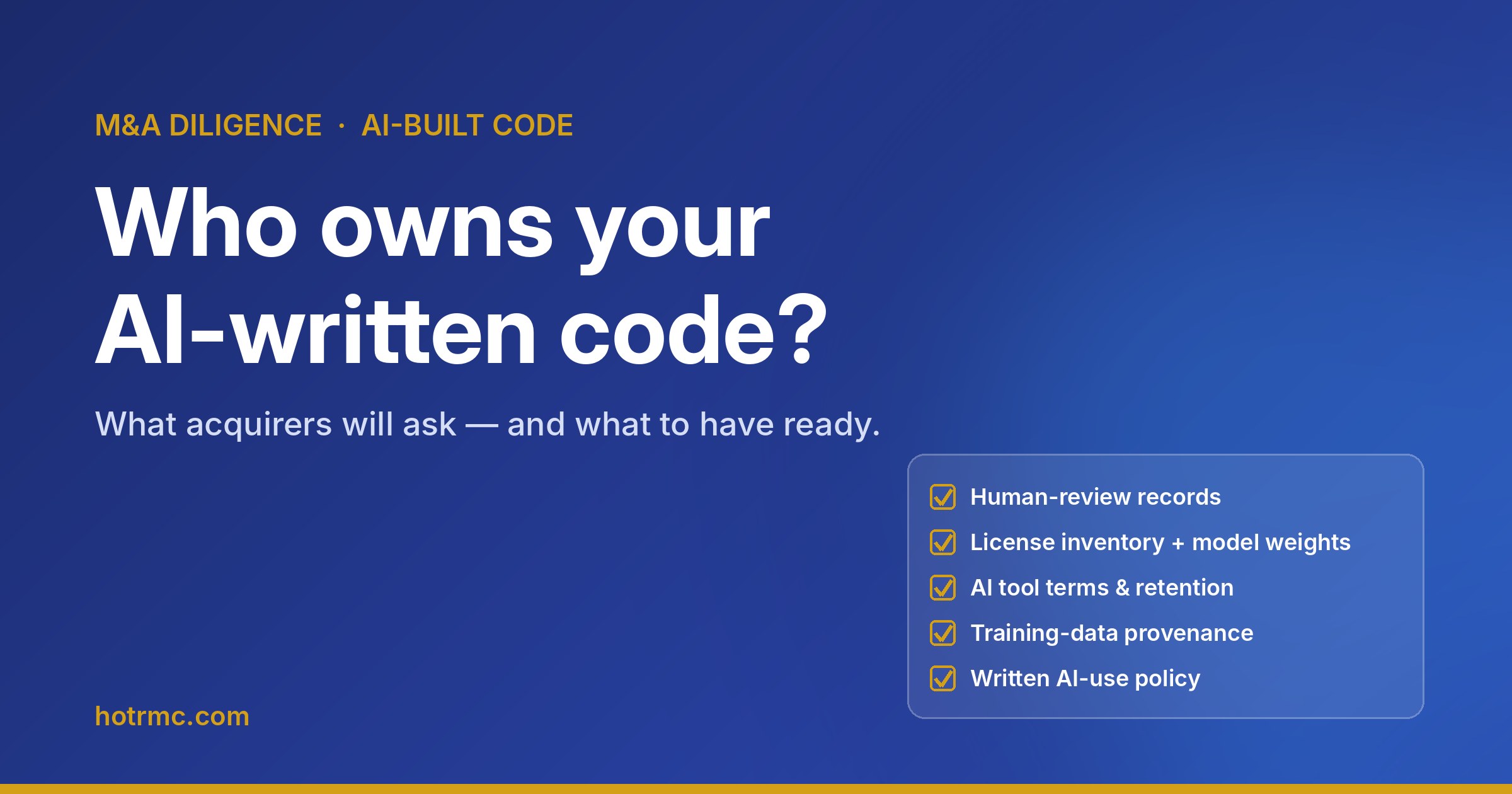
Buyers have started asking a question most engineering teams can't answer yet: who actually owns your AI-written code? Ownership isn't automatic, and diligence now asks for records of human review, a license inventory that includes model weights, your AI tools' data-retention terms, and governance evidence. Here's the five-part checklist to have ready before the data room opens, and why it's cheap to prepare now and brutal to reconstruct later.
Read more
How Investors Spot Technical Risk in a Portfolio Company — Before It's Expensive
By Tom Lang on October 5, 2026
You don't need to read code to spot a portfolio company headed for an expensive technical problem. The signals are all outside the codebase, and by the time they show up in the numbers, the problem is already costly. Here's how to read technical risk early, including the AI risk most people aren't reading yet, without commissioning a full audit.
Read more
The 5 Signs Your Engineering Is Quietly Burning Your Runway
By Tom Lang on October 5, 2026
Engineering rarely fails loudly. There's usually no single disaster, just a slow leak that looks like 'busy' right up until it looks like a crisis. Here are five signs, in business terms, that your engineering is costing you more than it should, and what each one actually signals. None of them are really code problems; they're judgment problems.
Read moreWant this turned into a prioritized, written plan?
That's what an AI-Augmented Technology Diagnostic is: fixed scope, fixed fee, about a week, ending in a written, prioritized plan you own. Or book a call and tell me what's going on.